Data mining permits useful extrapolation from sometimes obscure clues. Information which human experts have ignored as irrelevant has been eagerly snapped up by data mining software. This leads to interesting ethical questions.
Consider the risk of selling an individual automobile insurance for one year. Many factors are related to this risk. Some are obvious, such as incidence of previous accidents, traffic violations or average number of miles driven per year. Other risk factors may not be so obvious, but are nonetheless real. Suppose that it could be shown statistically that, when added to information already in use, late payment of utility bills incrementally improved prediction.
One might take the perspective that this is a business of prediction, not explanation, so- whatever the connection- this information should be added to the insurance risk model. This perspective reasons: if the connection is statistically significant, however strange it may seem, we should conclude that it is real and it should be exploited for business purposes.
Obviously, there is a countervailing perspective which has the customer asking, "What the... ? What do my utility bills have to do with my car insurance?" Even extremely laissez-faire governments may intervene in markets and forsake economic efficiency in favor of other priorities. In the United States, for example, certain types of discrimination in lending is illegal.
Another thing to consider (again, granting that the utility bill-automobile risk connection is real) is that, in prohibiting the use of utility bill payments in auto insurance risk prediction implies that less risky customers will be paying for riskier customers.
Thoughts?
Sunday, January 13, 2008


Friday, December 14, 2007
Three Critical Junctures
I don't know that it's possible to say that any single part of the data mining process is the "most important", but there are three junctures which are absolutely critical to successful data mining: 1. problem definition, 2. data acquisition and 3. model validation. Failures at other points will more often lead to loss in the form of missed opportunities.
Problem Definition
Problem definition means understanding the "real-world" or "business" problem, as opposed to the technical modeling or segmentation problem. In some cases, deliberation on the nature of the business problem may reveal that an empirical model or other sophisticated analysis is not needed at all. In most cases, the model will only be one part of a larger solution. This is a point worth elaboration. Saying that the model is only part of a larger solution is not merely a nod to the database which feeds to model and the reporting system which summarizes model performance in the field. The point here is that a predictive model or clustering mechanism must somehow be fit into the architecture of the solution some how. The important question here is: "How?" Models sometimes solve the whole (technical) problem, but in other situations, optimizers are run over models, or models are used to guide a separate search process. Deciding exactly how the model will be used with the total solution is not always trivial.
Also: attacking the wrong business problem all but ensures failure, since the chances of being able to quickly and inexpensively "re-engineer" a fully-constructed technical solution for the real business problem are slim.
Data Acquisition
Data acquisition refers to the actual collection of whatever data is to be used to build the model. If, for instance, sampling is not representative of the statistical universe to which to model will be applied, all bets are off. More than once, I have received analytical extracts of databases from other individuals which, for instance, contained no accounts with last names starting with the letter 'P' through 'Z'! Clearly, a very arbitrary sample had been drawn. The same thing happens all the time when database programmers naively query for limited ranges of account numbers or other record index values ("all account numbers less than 140000").
With larger and larger data sets being examined by data miners, the need for sampling will not go away in the foreseeable future. Sampling has long been studied within statistics and there are far too many pitfalls in this area to ignore the issue. My strong recommendation is to learn about it, and I suggest a book like Sampling: Design and Analysis Sampling: Design and Analysis by Sharon L. Lohr (ISBN-13: 978-0534353612).
Model Validation
Model validation gets my vote for "most important step in any data mining project". This is where- to the extent it's possible- the data miner determines how much the model really has learned. As I write this, it is the end of the year 2007, yet, amazingly people who call themselves "analysts" continue to produce models without delivering any sort of serious evidence that their models work. Years after the publication of "Magical Thinking in Data Mining: Lessons From CoIL Challenge 2000" by Charles Elkan, in which the dangers of testing on the training set were (yet again!) demonstrated, models are not receiving the rigorous testing they need.
"Knowing what you know" (and what you don't know) is critical. No model is perfect, and understanding the limits of likely performance is crucial. This requires the use of error resampling methods, such as holdout testing, k-fold cross-validation and bootstrapping. Performance of models, once deployed, should not be a surprise, nor a matter of faith.
Problem Definition
Problem definition means understanding the "real-world" or "business" problem, as opposed to the technical modeling or segmentation problem. In some cases, deliberation on the nature of the business problem may reveal that an empirical model or other sophisticated analysis is not needed at all. In most cases, the model will only be one part of a larger solution. This is a point worth elaboration. Saying that the model is only part of a larger solution is not merely a nod to the database which feeds to model and the reporting system which summarizes model performance in the field. The point here is that a predictive model or clustering mechanism must somehow be fit into the architecture of the solution some how. The important question here is: "How?" Models sometimes solve the whole (technical) problem, but in other situations, optimizers are run over models, or models are used to guide a separate search process. Deciding exactly how the model will be used with the total solution is not always trivial.
Also: attacking the wrong business problem all but ensures failure, since the chances of being able to quickly and inexpensively "re-engineer" a fully-constructed technical solution for the real business problem are slim.
Data Acquisition
Data acquisition refers to the actual collection of whatever data is to be used to build the model. If, for instance, sampling is not representative of the statistical universe to which to model will be applied, all bets are off. More than once, I have received analytical extracts of databases from other individuals which, for instance, contained no accounts with last names starting with the letter 'P' through 'Z'! Clearly, a very arbitrary sample had been drawn. The same thing happens all the time when database programmers naively query for limited ranges of account numbers or other record index values ("all account numbers less than 140000").
With larger and larger data sets being examined by data miners, the need for sampling will not go away in the foreseeable future. Sampling has long been studied within statistics and there are far too many pitfalls in this area to ignore the issue. My strong recommendation is to learn about it, and I suggest a book like Sampling: Design and Analysis Sampling: Design and Analysis by Sharon L. Lohr (ISBN-13: 978-0534353612).
Model Validation
Model validation gets my vote for "most important step in any data mining project". This is where- to the extent it's possible- the data miner determines how much the model really has learned. As I write this, it is the end of the year 2007, yet, amazingly people who call themselves "analysts" continue to produce models without delivering any sort of serious evidence that their models work. Years after the publication of "Magical Thinking in Data Mining: Lessons From CoIL Challenge 2000" by Charles Elkan, in which the dangers of testing on the training set were (yet again!) demonstrated, models are not receiving the rigorous testing they need.
"Knowing what you know" (and what you don't know) is critical. No model is perfect, and understanding the limits of likely performance is crucial. This requires the use of error resampling methods, such as holdout testing, k-fold cross-validation and bootstrapping. Performance of models, once deployed, should not be a surprise, nor a matter of faith.
Thursday, November 08, 2007
Random things...
I was just looking at my favorite economics blog, The Skeptical Optimist, and saw a post on randomness based on two books the blog author, Steve Conover is reading called The Black Swan and Fooled by Randomness. This caught my eye--a quote from one of the two books (it was unclear to me which one):
He then gives an example of two stock pickers, one of whom gets it "right" about 1/2 the time, and a second who gets it right 12 consecutive times. The punch line is this:
I personally don't agree philosophically with the role of randomness (I would prefer to say that many outcomes are unexplained then say randomness is the "reason" or "cause"--randomness does nothing itself, it is our way of saying "I don't know why" or "it is too hard to figure out why").
But that said, this is an extremley important principal for data miners. We have all seen predictive models that apparently do well on one data set, and then does poorly on another. Usually this is attributed to overfit, but it doesn't have to be solely an overfit problem. David Jensen of UMass described in one paper the phenomenon of oversearching for models in the paper Multiple Compisons in Induction Algorithms, where you could happen upon a model that works well, but is just a happenstance find.
The solution? One great help in overcoming these problems is through sampling--the train/test/validate subset method, or by resampling methods (like bootstrapping). But having the mindset of skepticism about models helps tremendously in digging to ensure the models truly are predictive and not just a random matching of the patterns of interest.
Here's an example of his point about randomness: How many times have you heard about mutual fund X's "superlative performance over the last five years"? Our typical reaction to that message is that mutual fund X must have better managers than other funds. Reason: Our minds are built to assign cause-and-effect whenever possible, in spite of the strong possibility that random chance played a big role in the outcome.
He then gives an example of two stock pickers, one of whom gets it "right" about 1/2 the time, and a second who gets it right 12 consecutive times. The punch line is this:
Taleb's point: Randomness plays a much larger role in social outcomes than we are willing to admit—to ourselves, or in our textbooks. Our minds, uncomfortable with randomness, are programmed to employ hindsight bias to provide retroactive explanations for just about everything. Nonetheless, randomness is frequently the only "reason" for many events.
I personally don't agree philosophically with the role of randomness (I would prefer to say that many outcomes are unexplained then say randomness is the "reason" or "cause"--randomness does nothing itself, it is our way of saying "I don't know why" or "it is too hard to figure out why").
But that said, this is an extremley important principal for data miners. We have all seen predictive models that apparently do well on one data set, and then does poorly on another. Usually this is attributed to overfit, but it doesn't have to be solely an overfit problem. David Jensen of UMass described in one paper the phenomenon of oversearching for models in the paper Multiple Compisons in Induction Algorithms, where you could happen upon a model that works well, but is just a happenstance find.
The solution? One great help in overcoming these problems is through sampling--the train/test/validate subset method, or by resampling methods (like bootstrapping). But having the mindset of skepticism about models helps tremendously in digging to ensure the models truly are predictive and not just a random matching of the patterns of interest.
Tuesday, October 23, 2007
Follow-Up to: Statistics: Why Do So Many Hate It?
In a question posted Oct-14-2007 to Yahoo! Answers, user lifetimestudentofmath asked:
How would you run this regression?
A relationship between beer expenditure and income was tested. The relationship may be qualitatively effected by gender. How would you test the hypothesis that women spend less money on beer than women?
My guess is that this is a homework question, and that the teacher wants students to use a dummy variable to represent gender, so that a simple interpretation of gender's coefficient will reveal the answer.
In reality, of course, the interaction of income and gender may yield a more nuanced answer. What if two regressions were performed, one for men and the other for women, with income as the predictor and beer expenditure as the target, and the regression lines crossed? Such a result precludes so simple a response as "men spend more on beer".
This question suggests another reason so many people hate statistics: its subtlety. The annoying thing about reality (which is the subject of statistical study), is that it is so complicated. Even things which seem simple will often reveal surprisingly complex behavior. The problem is that people don't want complicated answers. Although my response is: It is foolish to expect simple solutions to complicated problems, the fundamental, irreducible complexity of reality- which is mirrored in statistics- also drives negative feelings toward statistics.
How would you run this regression?
A relationship between beer expenditure and income was tested. The relationship may be qualitatively effected by gender. How would you test the hypothesis that women spend less money on beer than women?
My guess is that this is a homework question, and that the teacher wants students to use a dummy variable to represent gender, so that a simple interpretation of gender's coefficient will reveal the answer.
In reality, of course, the interaction of income and gender may yield a more nuanced answer. What if two regressions were performed, one for men and the other for women, with income as the predictor and beer expenditure as the target, and the regression lines crossed? Such a result precludes so simple a response as "men spend more on beer".
This question suggests another reason so many people hate statistics: its subtlety. The annoying thing about reality (which is the subject of statistical study), is that it is so complicated. Even things which seem simple will often reveal surprisingly complex behavior. The problem is that people don't want complicated answers. Although my response is: It is foolish to expect simple solutions to complicated problems, the fundamental, irreducible complexity of reality- which is mirrored in statistics- also drives negative feelings toward statistics.
Wednesday, October 17, 2007
Statistics: Why Do So Many Hate It?
In Why is Statistics So Scary?, the Sep-26-2007 posting to the Math Stats And Data Mining Web log, the author wonders why so many people exhibit negative reactions to statistics.
I've had occasion to wondered about the same thing. I make my living largely from statistics, and have frequently received unfavorable reactions when I explain my work to others. Invariably, such respondents admit the great usefulness of statistics, so that is not the source of this negativity. I am certain that individual natural aptitude for this sort of work varies, but I do not believe that this accounts for the majority of negative feelings towards statistics.
Having received formal education in what I call "traditional" or "classical" statistics, and having since assisted others studying statistics in the same context, I suggest that one major impediment for many people is the total reliance by classical statisticians on a large set of very narrowly focused techniques. While they serve admirably in many situations, it is worth noting the disadvantages of classical statistical techniques:
1. Being so highly specialized, there are many of these techniques to remember.
2. It is also necessary to remember the appropriate applications of these techniques.
3. Broadly, classical statistics involves many assumptions. Violation of said assumptions may invalidate the results of these techniques.
Classical techniques were developed largely during a time without the benefit of rapid, inexpensive computation, which is very different from the environment we enjoy today.
The above were major motivations for me to embrace newer analytical methods (data mining, bootstrapping, etc.) in my professional life. Admittedly, newer methods have disadvantages of their own (not the least of which is their hunger for data), but it's been my experience that newer methods tend to be easier to understand, more broadly applicable and, consequently, simpler to apply.
I think the broader educational question is: Would students be better served by one or more years of torture, imperfectly or incorrectly learning myriad methods which will soon be forgotten, or the provision of a few widely useful tools and an elemental-level of understanding?
I've had occasion to wondered about the same thing. I make my living largely from statistics, and have frequently received unfavorable reactions when I explain my work to others. Invariably, such respondents admit the great usefulness of statistics, so that is not the source of this negativity. I am certain that individual natural aptitude for this sort of work varies, but I do not believe that this accounts for the majority of negative feelings towards statistics.
Having received formal education in what I call "traditional" or "classical" statistics, and having since assisted others studying statistics in the same context, I suggest that one major impediment for many people is the total reliance by classical statisticians on a large set of very narrowly focused techniques. While they serve admirably in many situations, it is worth noting the disadvantages of classical statistical techniques:
1. Being so highly specialized, there are many of these techniques to remember.
2. It is also necessary to remember the appropriate applications of these techniques.
3. Broadly, classical statistics involves many assumptions. Violation of said assumptions may invalidate the results of these techniques.
Classical techniques were developed largely during a time without the benefit of rapid, inexpensive computation, which is very different from the environment we enjoy today.
The above were major motivations for me to embrace newer analytical methods (data mining, bootstrapping, etc.) in my professional life. Admittedly, newer methods have disadvantages of their own (not the least of which is their hunger for data), but it's been my experience that newer methods tend to be easier to understand, more broadly applicable and, consequently, simpler to apply.
I think the broader educational question is: Would students be better served by one or more years of torture, imperfectly or incorrectly learning myriad methods which will soon be forgotten, or the provision of a few widely useful tools and an elemental-level of understanding?
Tuesday, October 16, 2007
See The World
I recently had the pleasure of attending the Insightful Impact 2007 conference, where I especially enjoyed a presentation on ensemble methods by two young, up-and-coming, aspiring data miners: Brian Siegel and his side-kick... Deke Abbott, or Dean Abner, or some such.
I am frequently asked what is the best way to learn about data mining (or machine learning, statistics, etc.). I get a great deal of information from reading, either books or white papers and reports which are available for free, on-line. Another great learning experience involves attendance of conferences and trade shows. I don't travel a great deal and find it convenient to attend whatever free or cheap events happen to be within close distance. I also try to get to KDD when it's on the east coast of the United States. Aside from the presentations, events like these are an opportunity to get away from the muggles and spend some time with other data miners. I highly recommend it.
Nice job, Dean and Brian.
I am frequently asked what is the best way to learn about data mining (or machine learning, statistics, etc.). I get a great deal of information from reading, either books or white papers and reports which are available for free, on-line. Another great learning experience involves attendance of conferences and trade shows. I don't travel a great deal and find it convenient to attend whatever free or cheap events happen to be within close distance. I also try to get to KDD when it's on the east coast of the United States. Aside from the presentations, events like these are an opportunity to get away from the muggles and spend some time with other data miners. I highly recommend it.
Nice job, Dean and Brian.
Friday, August 31, 2007
Interesting real-world example of Simpson's Paradox
At MineThatData blog there is a very interesting post on email marketing productivity was very interesting, and a good example of Simpson's Paradox (as I posted in the comments). The key (as always) is that there are disproportionate population sizes with quite disparate results. As Kevin points out in the post, there is a huge difference between the profit due to engaged customers vs. those who aren't engaged, but the number of non-engaged customers dwarfs the engaged.
The problem we all have in analytics is finding these effects--unless you create the right features, you never see it. To create good features, you usually need to have moderate to considerable expertise in the domain area to know what might be interesting. And yes, neural networks can find these effects automatically, but you still have to back out the relationships between the features found by the NNets and the original inputs in order to interpret the results.
Nevertheless, this is a very important post if for no other reason but to alert practitioners that relative sizes of groups of customers (or other natural groupings in the data) matter tremendously.
The problem we all have in analytics is finding these effects--unless you create the right features, you never see it. To create good features, you usually need to have moderate to considerable expertise in the domain area to know what might be interesting. And yes, neural networks can find these effects automatically, but you still have to back out the relationships between the features found by the NNets and the original inputs in order to interpret the results.
Nevertheless, this is a very important post if for no other reason but to alert practitioners that relative sizes of groups of customers (or other natural groupings in the data) matter tremendously.
Tuesday, August 21, 2007
Little League pitch counts -- data vs decisions revisited
I posted recently on the new rules in pitch counts for Little League. I've had to defend my comments recently (in a polite way on this blog, and a bit more strenuously in person with friends who have sons pitching in LL), but was struck again about this issue while watching the LL World Series on ESPN.
On the ESPN web site I read this article on pitch counts, and found this comment on point:
In other words, coaches know that it isn't pitch counts per se that cause the problems, but rather the number of months of the year the kids are pitching.
Interestingly, there is no ban on breaking pitches, though when I talk to coaches, there is speculation that these cause arm problems. In fact, on the Little League web site, they state:
I'm glad they are studying it, but the decision not to act to ban breaking pitches due to a lack of data is interesting since there is also a lack of data with pitch counts, but it didn't stop the officials from making rules there! Hopefully with the new pitch count rules, and the new data collected, we can see of the data bears out this hypothesis.
On the ESPN web site I read this article on pitch counts, and found this comment on point:
What's interesting here is that the 20-pitch specialist is the residue of a change that did not, strictly speaking, emanate from problems within Little League itself. Around the coaching community, it is widely understood that the advent of nearly year-round travel (or "competitive") ball is one of the primary reasons for the rise in young arm problems. In some ways, Little League has made a pitch-count adjustment in reaction to forces that are beyond its control.
Travel ball has become an almost de facto part of a competitive player's baseball life -- just as it has in soccer, basketball and several other youth sports. An alphabet soup of sponsoring organizations, from AAU to USSSA, BPA and well beyond, offers the opportunity to play baseball at levels -- and sheer numbers of games -- that a previous generation of players would have found mind-boggling.
But travel ball is here to stay -- and so too, apparently, is a new approach by Little League to containing the potential damage to young arms. So get used to the 20-pitch kid. He's a closer on the shortest leash imaginable.
In other words, coaches know that it isn't pitch counts per se that cause the problems, but rather the number of months of the year the kids are pitching.
Interestingly, there is no ban on breaking pitches, though when I talk to coaches, there is speculation that these cause arm problems. In fact, on the Little League web site, they state:
While there is no medical evidence to support a ban on breaking pitches, it is widely speculated by medical professionals that it is ill-advised for players under 14 years old to throw breaking pitches,” Mr. Keener said. “Breaking pitches for these ages continues to be strongly discouraged by Little League, and that is an issue we are looking at as well. As with our stance on pitch counts, we will act if and when there is medical evidence to support a change.
I'm glad they are studying it, but the decision not to act to ban breaking pitches due to a lack of data is interesting since there is also a lack of data with pitch counts, but it didn't stop the officials from making rules there! Hopefully with the new pitch count rules, and the new data collected, we can see of the data bears out this hypothesis.
Wednesday, August 15, 2007
KDNuggets Poll on "Data Mining" as a term
KDNuggets has a new poll on whether or not "data mining" should still be used to describe the kind of analysis we all know and love. It is still barely winning, but interesting, Knowledge Discovery is almost beating it out as the better term.
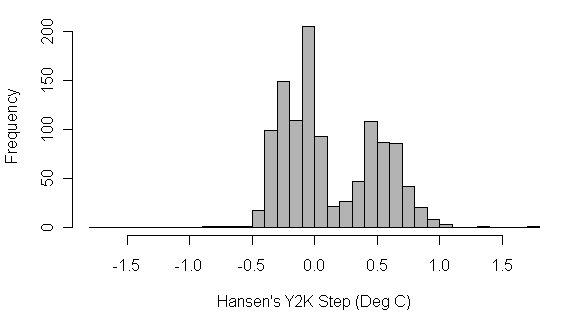
The latest Y2K bug--and why mean values don't tell the whole story
I was interested in the recent hubbub over surface temperatures as first written in NASA's Daily Tech, and picked up by other news sources. (Note: the article doesn't render well for me in Firefox, but IE is fine).
However, I found this article describing the data even more interesting, from the Climate Audit Blog. From a data mining / statistics perspective, it was the distribution of the errors that was interesting. I had read in the media (sorry-don't remember where) that there was an average error of 0.15 deg. C due to the Y2K error in the data--that didn't seem too bad. But, at the blog, he describes that the errors are (1) bimodal, (2) postively skewed (hence the positive average error), and (3) typically much larger than 0.15 deg. So while on average it doesn't seem bad, the surface temperature errors are indeed significant.
Once again, averages can mask data issues. Better to augment averages with other metrics, or better yet, visualize!
However, I found this article describing the data even more interesting, from the Climate Audit Blog. From a data mining / statistics perspective, it was the distribution of the errors that was interesting. I had read in the media (sorry-don't remember where) that there was an average error of 0.15 deg. C due to the Y2K error in the data--that didn't seem too bad. But, at the blog, he describes that the errors are (1) bimodal, (2) postively skewed (hence the positive average error), and (3) typically much larger than 0.15 deg. So while on average it doesn't seem bad, the surface temperature errors are indeed significant.
Once again, averages can mask data issues. Better to augment averages with other metrics, or better yet, visualize!
Subscribe to:
Posts (Atom)


 Posts
Posts